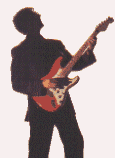
Hank Marvin
IN THE BEGINNING THERE WAS HANK
by Paul Guy© Paul Guy 2002
Interview for FUZZ magazine # ??/??
As a staff writer for the Swedish guitar magazine FUZZ I have had the distinct pleasure of interviewing a number of my early guitar heroes - Jeff Beck, Steve Cropper, Buddy Guy and Albert Lee among others - but never the first guitarist that I ever tried to emulate, namely Hank Marvin. The very first tune I ever learned all the way through (well, more or less) was ”Apache”... So when Hank came to Sweden on his ”Final Tour” earlier this year it suddenly became a matter of urgency to try to arrange an interview. FUZZ had tried to get an interview on previous visits, but the perpetual mantra from the record company was always the same: ”Hank doesn’t give interviews”, full stop. But I couldn’t let this last chance slip by me, so this time I decided to go direct to the source, and play my trump card.
I’ll let you in on a secret - over 40 years ago, I was a member of the Cliff Richard and The Shadows Fan Club, one of 90 boys among some 18,000 girls. The club was run by a girl called Jan Vane, who felt sorry for the boys - they never seemed to win any prizes in the monthly fan club contests. She announced a ”boys only”contest - ”Pick a name for a pop group”. The judges were Hank and Bruce Welch, as I recall. My offering was ”The Spectacles”... I guess all the other entries must have been rubbish, because I won. The prize was the red ”sharkskin” suit Cliff wore in the concert scene with the Shadows at the end of the film ”The Young Ones”, signed by Cliff in the lining (with a nice white shirt and under-collar bow tie). It hangs in my wardrobe to this day. Not that I can even get into the jacket now - I had grown out of the trousers by the time I was 18. But it’s cool. It’s very cool.
So I wrote a personal letter to Hank, related this story, and asked very politely if he would grant me an interview. I had this delivered by motorcycle messenger to his dressing room at the Concert House in Gothenburg the evening before he was to perform in Stockholm, where I live. To my delight and surprise Hank’s tour manager rang about an hour and a half later - I was welcome to meet Hank over lunch at his hotel in Stockholm the next day! So here is an exclusive interview with a living legend, the man who inspired a whole generation of guitar players, and even many of their children, Hank Marvin, lead guitarist of The Shadows.
Hank Marvin and Bruce Welch met in their hometown of Newcastle, and formed a band called The Railroaders in 1957. They soon moved to London, and changed their name to The Chesternuts when singer Peter Chester joined them for their first single release. Cliff Richard’s manager discovered Hank at the legendary ”2 i’s” coffee bar, and invited him to audition for Cliff’s group The Drifters. Hank accepted, on the condition that his friend Bruce was included in the deal. Also in the group at the time were bass guitarist Paul Samwell and drummer Terry Smart. Jet Harris took over the bass in October 1958, and Tony Meehan replaced Smart the year after, completing the classic lineup.
Cliff Richard had already hit in a big way in mid-1958 with his first single release ”Move It”, followed up by a row of Top 5 and Number One hits. The Drifters released a couple of singles, but neither made any great inroads on the charts. In October 1959 the group changed its name to The Shadows, when the American vocal group The Drifters gained an injunction forbidding them to use the name in the USA. (Cliff and The Shadows made one visit in 1960, but never really broke in the States.) ”Apache”, released in July 1960, was a huge hit, staying on the Top 40 for over 20 weeks. (Dutch guitarist Jorgen Ingmann scored the hit with the Jerry Lordan tune in the States.) The Shadows had more than 25 English Top 40 hits before they split up in 1968. If you count in the 33 hit singles they recorded with Cliff Richard the group had more English Top 40 hits than The Beatles.
Hank Marvin’s influence in rock guitar circles is indisputable, and cannot be overstated. Gary Moore, Ritchie Blackmore, Brian May, Tony Iommi, Peter Green, Mark Knopfler, Peter Frampton, Andy Summers - when all these guys (and all the rest of us) took their first stumbling steps on the road to guitar proficiency, ”Apache”, ”Man Of Mystery”, ”F.B.I.” or maybe Cliff’s ”Livin’ Doll” were among the first tunes they tried to learn. Any budding guitarist more or less had to learn them, to have any chance of passing an audition to play in a band at all. (If you were really good, you could even play ”Foot Tapper”.) The singer in Jeff Beck’s first band, The Deltones, has related that the band were infinitely impressed by Beck’s ability to play Shadows tunes ”just like Hank” when he auditioned for them. Beck has spoken dismissively of this, but I still think I can hear echoes of Hank in his playing even today, particularly in his use of the vibrato bar and on some of the slow ballads. Marvin’s influence on the other side of the Atlantic has become more widely appreciated in later years, in spite of the fact that neither Cliff Richard nor The Shadows ever really broke in the States in any big way. Artists as diverse as Steve Stevens, Neil Young, Randy Bachman and Bela Fleck have all named Hank Marvin among their influences.
It’s hard to tell that the slim, smiling figure approaching me in the lobby is 60 years old. Hank Marvin doesn’t look it, even att close range. But he doesn’t want us to take any photos - a Norwegian paper had recently printed a picture he didn’t like at all. Hank is just as relaxed as he looks in pictures - and on the concert stage, for that matter. He seems to be an open, friendly and kind-hearted man, and is surprisingly interested in discussing techicalities about his guitars and equipment, despite more than 40 years in the business. He also has a typically British sense of humour, understated and self-deprecating, and a ready laugh.
So - the big question on everybody’s minds is, on the posters it says - ”The Final Tour” - that’s the final word, is it?
- The final solution! (laughs) - well, I suppose everyone at some point must make a decision whether to continue touring. I’m very careful about this, because I don’t want to shut any doors. I have no intention of doing any more of these long, intensive tours. But that’s not to say I might not do something in the form of live work at some point, maybe of a very short duration, or something that interests me, whatever, in the future - I simply don’t know at this stage. But just to recap, I certainly don’t want to do any more of these long tours. So yes, this is The Final Tour.
But your’e not giving up playing?
- Not entirely, no. I’m going to have a long rest, though. I shall go into intensive care after the tour! (Laughs) Because we have 64 concerts on this one- when I finish the dates in Scandinavia we have another 50 in the UK. Everyone at the end of a tour like that - the band, the crew, everyone - really feels like we’re ready for a break. It’s pretty gruelling.
Yeah, I’ve been there - not on that level, but I’ve played 6 nights a week for 9 months on the trot, so I know, it’s hard work.
- It is. It’s not so much the performances, funnily enough - I think we all enjoy the performances - it’s the travelling, you’re constantly having late nights, sometimes early mornings because of having to catch flights - and then perhaps interviews on local radio, or local TV. It makes the days often very long, and very demanding. And when that goes on for that amount of time, it can - harrumph! - for a man of my age - (laughs) it can be - knackering!
You’re going to be 60 this year, is that right?
- I am 60, I was 60 last October. But I appreciate the thought!
LAST October? Congratulations!
You’ve been living in Australia for the past - what? - 15 years?
- 15 years plus now, almost 15 -1/2. Yes.
What was the big attraction with Australia?
- Several things, really. We live in Perth, Western Australia - the weather is a Mediterranean climate there, I prefer warmth to cold - and less people, less traffic...
Cleaner air, maybe?
- Well, yes - you get a feeling that the city is generally cleaner than say, British cities anyway. You’ve got great beaches, lovely countryside, great food over there - eating out is pretty cheap over there. It seems to be the quality of life generally is better. And because I - and my family, my wife - we prefer a place where there is less traffic and less people, it suits us. It seems as though there’s therefore less pressure. You just feel more relaxed in that kind of environment, I think.
And then of course there’s the Aussies, they’re kind of special too.
- Yeah, they’re very relaxed people, generally, in their approach to things. But then having said that, they get a lot of things done. They’re quite a creative people, really - a lot of inventions, I was surprised, come out of Australia - and they do very well at sports, and some very good music has come out of Australia. So whilst they’ve got this ”She’ll be right, mate” attitude, they still seem to get quite a lot of stuff done, and creative ideas, and things.
You know’ it’s funny, but all these years - I never found out until last night that Hank Marvin wasn’t your real name.
- Well it is my real name, but I wasn’t born with that name. I changed it when I was 18. So it is my real name, the other one doesn’t exist! Funnily enough, there was a period - maybe if I was coming into the music scene now as a youngster, I perhaps wouldn’t change my name. But in those days it seemed to be the thing to do, everybody had a stage name.
Right - you couldn’t call yourself Harry Webb (Sir Cliff Richard’s given name) back then, could you? It was all Adam Faith, and Billy Fury, and Rory Storm!
- That’s right. It just seemed the way to go, I’d been known as Hank for many. many years, so that just stuck. The ”Marvin” I got from {country singer} Marvin Rainwater - I thought ”I love the sound of that name Marvin, it sounds good.”
You got the ultimate accolade really, didn’t you - your name became London rhyming slang! {”I’m Hank (Marvin)!” = I’m starving (hungry)}
- So it was a good move, you see! The other one could have been rhymed with something else - very unfortunate! (Laughs)
(Interviewer collapses in helpless laughter...) {Hank Marvin was christened ”Brian Robson Rankin”...} (Wiping tears from eyes) Well, you’re still using the Custom Shop Strats, obviously, but you’ve been doing a lot of acoustic work recently.
- On stage I use three of the Custom Shop Strats. the signature models - simply because they’re all strung with different gauge strings. I use heavy strings for the old Shads stuff, and I use 11 to 50’s for most of the stuff, that’s my kind of compromise string gauge. Then we do a rock medley where I attempt a little bit of country style playing on one number, where I use 10 to 46’s. I sort of prefer the sound of the heavier strings really. But getting back to the acoustics, ever since I’ve been doing the solo tours we’ve had a little acoustic set, and it’s always gone very well, and with this new album - the ”Guitar Player” album - we’re doing a little more acoustic on this tour, we’re doing six tracks from the album. And I enjoy playing acoustic, I kind of got into it over the last - ten years, I suppose.
Well of course it’s become a lot easier now, with the modern pickup systems, hasn’t it?
- Oh yes!
I remember seeing you at the Concert House about 15 years ago with the Shadows, you were doing an acoustic set back then too.
- Were we singing with the acoustics?
That’s right, yes.
- I’ve done a bit of that with my band, but this is all instrumental, it’s all tracks from the album.
Do you still do the Chinese number?
- The Chinese one with the tuning up?
Too-nin, yeah! (The Shadows’ traditional ”And now we’re going to do a little Chinese number called Too-Nin...”)
- (Laughs) I forgot that one. I should stick it in again! Thanks for the memories! (Laughs) On stage, we do a couple of numbers which have acoustic solos in the middle of them, where I have the guitar on a Gracie stand, and I switch from electric to acoustic. But the guitar I’m mainly using is a guitar I had made for me - it’s in the style of the old Selmers that Django Reinhardt used, it’s a Dave Hodson guitar. On the album I used a French Flavino, which is the same sort of guitar. But it wasn’t amplified, and I thought, well - and it’s also got the marker dot at the tenth fret, instead of the ninth fret, which at first totally threw me until I got used to it. I couldn’t work out why I kept playing in the wrong key every time I went up the fingerboard! But once I realised what it was - I’ve got used to it now, but I thought on stage it could be a bit of a problem. I’ve already got enough to worry about, I’ve got three different lots of string gauges on the Strats, and obviously everything feels different - using two different acoustic guitars, and this one has a long scale, as you probably know, 26-1/2 inch scale on the Selmers, and the Selmer-style guitars - and I thought, if I’ve also got the marker dot in the wrong place, on live work, this could become very confusing. So I got Dave Hodson in England, who has quite a reputation for making these guitars - he was able to make me one in four weeks, which is something of a world record, I think. And it’s still wearing in a little bit, it sounds good though. It’s giving me that sort of sound - I hope it is anyway! - that’s on most of this album, that very midrange Selmer sound. We’ve got a Fishman Blender setup in that one. But unfortunately, the problem you have with acoustics when you’re using monitors in front of you because you’ve got electric bass and drums, they’re prone to feedback, so on the monitoring system they have to cancel out the frequencies that tend to start feeding back, which means you lose a lot of the tone, and you end up with an unpleasant tone most of the time. And it’s not nice to play. But there’s no way round it, using the monitors as we do. The only other way round it is to have the monitors alongside, but we can’t have that for the rest of the show, so it’s a bit of a problem.
You had the very first Fender Strat in England, didn’t you?
- Yes, Cliff (Richard) bought it for me in the States, you couldn’t buy them in England back then. That first Strat - when we were able to get Strats through Jennings, who became the distributors for Fender once the import ban was lifted - I gave Cliff that guitar back, because we got matching red ones, and that new red was slightly different. And Cliff kind of put it in a cupboard, then he now and again got it out and played a number on stage himself. Then he had it sprayed white, and according to Bruce, Cliff gave him that guitar. But according to Cliff, he lent him it... So I don’t know quite where the truth lies, but Cliff reckons it’s on permanent loan, but Bruce reckons he gave him it. He’s hanging on to it!
That’s worth a few bob now!
- Yeah! I have a ’58 red Strat, though, which I did use on stage through the 80’s - until I got the signature models - and that’s a nice guitar. The good thing about the Custom Shop models, the ones I’ve got now, we were very concerned about trying to get them to stay in tune better. So we’ve got a Teflon nut, no string trees, and locking machne heads. And originally we had the new kind of tremolo block on it, the American Standard, but then Chris Kinman in Australia, whose pickups I use, recommended to me that I went back to the other ones, the vintage ones - he said they do sound better. And if it’s set up properly, it won’t go out of tune. And he sent me this Japanese copy of a Fender that he just tries his pickups out on, and he said, just try this tremolo - and it was great, didn’t go out of tune at all. So anyway, it’s all done now, and they’re the bridges I have, and they work very well, and they do stay in tune very well.
Oh yes, especially with the locking machine heads and the Teflon nut, that does the trick. I’m impressed with those Kinman pickups, too - I put a set on a Strat for one of your fans last week.
- They’re good, aren’t they? Was that the vintage set?
No, that was the ”modern” Hank Marvin set.
- Yeah. Slightly warmer.
Well of course back in the late 50’s, early 60’s, when you couldn’t get these thin strings, you were getting the fatter sound because of the fatter strings.
- That’s right. What we had was - I checked this out with Fender about 15 years ago. One of the guys who was around in the late 50’s was still around then, and he reckoned that the 3rd was a wound 26, that’s how they left the factory. Something like a 14 down to a 56. And I know they were heavy, but - great sound. But also I think what we have to keep in mind is, I know the pickups on the original Strat that Bruce and I had, and on my ’58 Strat, actually did have quite a warm sound compared to other Strats I’ve heard, not so brittle-sounding. So you had the thick strings, and the early Vox amplifiers which we had did not have top boost, that was a later invention of Dick Denney, who was deaf anyway! (Mutual laughter) There was a bizarre thing, an amplifier manufacturer and designer who’s deaf!
It goes with the territory, I guess! I spoke to Dick once a few years ago when I was researching an article, he was quite a character.
- Yes he was. He reminded me when I met him about two years ago - he died, you know, about a year ago?
Yes, I was sorry to hear that.
- He was reminding me about when we were using the Vox AC15’s - and apparently I said to him, can’t you put two of them together to make a louder amp, cause we couldn’t hear ourselves on stage for all the screaming - and he said the first AC30 he came up with had a smaller cabinet than the final production model. Because in my mind we were using - when we first went to ths States, 1960 - I was convinced we took AC30’s with us, and every one of them blew up on the first day. And therefore when we made Apache, I thought we were using AC30’s. And he said, ”No you weren’t, you were using AC15’s, I’ve seen a photograph of the session.” But I think what it was, I think it was the early AC30, before it went out with a slightly smaller cabinet, so it didn’t look quite the same. Maybe.
I remember reading a book about The Shadows back at the beginning of the 60’s, but I can’t remember the title?
- There was a book written in about 1961, I think - ”The Shadows By Themselves”, it was called. By Royston Ellis. He was a young ”Beat Poet”. He wrote very off-beat poetry, but he like to recite it to music, and we did a couple of gigs for fun with him - Jet Harris, Tony Meehan and myself. And we just played absolutely - drivel. It was totally free-form rubbish, we’d just get a beat going, it was absolutely shocking stuff. And he would sit there and be going ”Ah-be-dum-be-dum”... He was an early hippie, he had the hair and the beard, which in 1961 was very far out. He was only a young guy, in his late 20’s I think - a very bohemian character. But it was fun. And then we did a book in the 80’s which Mike Reid. a radio personality in England, he did it. It was all right. The trouble is with these sort of books, if you keep it fairly innocuous, it can become a bit bland. And I don’t like digging up the dirt - it’s easy to dig up dirt about other people, isn’t it, that you’ve worked with, or had a relationship with, or something. And I think that’s unfair, like when people name ex-girlfriends, or ex-boyfriends - it was 20 or 30 years ago, and we did this, we did that - what’s the point now? It puts them in an embarassing situation, perhaps - etcetera etcetera. I don’t go for that sort of journalese personally. So from that point of view it can end up being a little bit bland. I think that today, my personal view is that a lot of people seem to enjoy the sort of spicy biography.
It’s like all the nonsense people used to talk about Cliff - he never created enough scandal, so he never used to get left alone, did he.
- Well it’s an interesting thing that back in the late 50’s, early 60’s, because of the attitude of society generally, what was acceptable - we had a publicist called Les Perrin, who was very good, back at the time. Les was one of the best guys, a very nice man. And there were times when things happened, and Les, because of his contacts, would keep things quiet. Whereas - push on three years, if we had been a new band coming up then, we would have probably wanted them to get in the press, because it would have made us look really greasy!
When you think about when the Rolling Stones started up, and everybody was so shocked by what hey looked like - and if you look at a picture of them from that time today, you think, so what? My father thought they were the worst bunch of yobbos going, but he never objected to The Shadows!
- Well funnily enough, when the Stones first appeared, I remember seeing them - we were doing a summer season in Blackpool, and we saw them on one of those pop shows, I can’t remember which one it was - Thank Your Lucky Stars, or one of those - Keith Fordyce introduced it - and they were very smart actually, they had black and white dogstooth jackets with velvet collars, and ties on, and they all had very short hair. In fact Mick Jagger said something to Keith - ”You bet us we wouldn’t not have a haircut until next time we came on the show, and we haven’t!” And quite honestly, it wasn’t that long at all! It was a bit over the ears, but not at all what it was maybe a year or so later. So really that initial image they had was not the rebellious one that probably happened within about a year, and that was a manufactured thing. Andrew Loog Oldham created that - he knew the time was right for the rebellious image, there wasn’t a band around, or an artist - there was in the 50’s, but that had gone, and everything was sweet, and boy next door, and it was very clever. He manufactured things which got them fantastic - at the time, it was thought bad publicity, but I’ll tell you what - it worked, and a lot of the kids could relate to it.
On another note - what are you using for amplifiers nowadays?
- On the last tour two years ago, the guys who developed my echo system - I use a thing called Echoes From The Past - and Charlie Paul who got the system together had the brainwave of sampling every Shadows record, and every one of mine, to work out the echo things. So he worked them all out, and he’s even put a bit of wow and flutter on some of the old ones. And it’s great for stage, because obviously it’s noise-free - it sounds very authentic, and because it’s a digital device, I could actually change programs myself with a pedal, but to save me the hassle, my guitar tech changes it for each number. And if we do a medley, for example, I can get the correct echo for each number. And it’s ideal, because before everything had to be a compromise really - all-purpose echo for the next three numbers, really. And these guys had the bright idea of designing an amp - so Charlie and his off-sider Pete, and Ken, who’s an amp repair man and designer, he makes just one-offs for people - they got together and made this amp. And they brought it to me two years ago before a tour. I said, well, I’ll give it a whirl, we didn’t have time to really do a proper test, because we were running out of time with rehearsals. So I said we’ll take it with us, we’ll try it on tour. So we did an A/B test against the Matchless, and I thought it sounded a lot better, which I was really surprised at. They originally brought two cabinets in, two slightly different designs - the use of the wood, one was pine, the other was maybe ply, I don’t know. One cabinet sounded better to me - it had a much tighter low end - plenty of low end, but really defined, not one of those floppy bottom ends. And they were using Jensen speakers, because the Celestions aren’t always that tight on the low end. The ones Matchless use, they artificially age them, I think, they do something to them to get a better sound - and it is a better sound. But anyway, I thought, this sounds terrific - so we took them on tour, did some A/B’s on a few sound checks, and I just loved the mid-range on it, and the high end - it’s very clean, but to me it’s got more guts than the Matchless. And the sound guy said, that amp really does sound very good, it’s a lovely high end. I don’t know what the correct technical term would be, but some amplifiers to me sound a bit tinkly when you get up high, like Fenders. And I think that the Matchless is inclined that way. Voxes didn’t. This to me sounds a bit more - the guts of a Vox, but some of the refinement of a Matchless, if you know what I mean.. They’re called KCP - Ken, Charlie and Pete. But I think they’re terrific amps, I really do. Like I said that mid-range is very clean, and the high end has got real strength in it - but it’s still got that sound that I’m associated with, perhaps more so than the Matchless, which I thought were very good. They’re now producing them, they’re hand made - but they’re a lot cheaper than a Matchless. I suppose they’re more expensive than a Vox, but then a Vox is not hand made. They’re using quality components in these amps - I mean, we toured Voxes for years, and with us they had a terrible record of reliabilty. I’ve spoken to a lot of people who use them, and it’s always the same story. Some of the problems were associated with the proximity of some of the components, so they got too hot. Another problem we found was with the jack sockets, we had a few of those go. It was just a very poor quality jack socket.
Those old English Re-An plastic jack sockets!
- Exactly, yeah! John Jorgensen - the guitarist with the Hellecasters - told me - cause he used to use Voxes years ago - the guy who used to repair them all lived in Cleveland, and he flew some of his amps up to get them fixed, cause they were always breaking down - and this guy used to modify them so they didin’t break down. So he said to him, well, why don’t you build some amps, like you’re basically rebuilding the Vox, build some amps and sell them? And he finally persuaded him, and he came up with the first Matchless, and that’s how it started. If you ever get to meet John, you can ask him if it’s a true story!
We haven’t heard the last of Hank Marvin. Live long and prosper, Hank!
© Paul Guy, 2002 Back to article list